

News and articles
Collection of posts and thoughts...
Posted to LinkedIn 7 October 2025
Robert Jenrick’s proposals to politicise judicial appointments and introduce a parliamentary mechanism for dismissing judges are not a fix, they’re a threat.
The UK judiciary is not perfect, but its independence is a cornerstone of democratic accountability. Scrapping the Judicial Appointments Commission and handing selection powers back to ministers would drag the courts into the political arena, undermining public trust and judicial impartiality.
Let’s be clear: judges are not activists because they apply the law in ways politicians dislike. The role of the judiciary is to interpret legislation, uphold rights, and ensure executive action is lawful. If immigration decisions are “absurd,” the remedy lies in clearer legislation, not in purging judges who apply existing law with integrity.
Jenrick’s plan would:
- Erode the separation of powers by making judicial careers contingent on political favour
- Impact judicial independence, especially in cases involving government overreach
- Risk turning courts into partisan battlegrounds, where legal reasoning is second to political loyalty
The idea of a “judicial investigative office” empowered to remove judges for perceived activism is especially dangerous. Who defines activism? A judge citing precedent on asylum rights? A ruling that criticises Home Office procedures? These are legal judgments—not political acts.
If we want a judiciary that serves the public, not the government, we must protect its independence not dismantle it.

Posted on LinkedIn 6 October 2025
The current political trend in the UK to pledge to withdraw from the European Convention on Human Rights (ECHR) marks a dangerous turning point, not just legally, but morally.
The ECHR isn’t a foreign imposition. It was co-authored by British lawyers in the aftermath of WWII to prevent tyranny and protect dignity. It has helped victims of injustice, from Hillsborough families to survivors of abuse, hold institutions to account.
Yet today, it’s being scapegoated for policy failures. Immigration, veterans’ rights, and housing allocation are complex challenges. Blaming the ECHR for legal constraints is politically convenient, but legally incoherent. The Convention doesn’t block action; it demands that action be lawful, proportionate, and rights-respecting.
Leaving the ECHR would:
- Undermine the Good Friday Agreement and devolved settlements
- Erode protections for ordinary citizens, not just migrants
- Isolate the UK from key international cooperation frameworks
- Set a precedent that rights are expendable when politically inconvenient
This isn’t about sovereignty. It’s about accountability. The ECHR ensures governments act within bounds—especially when the stakes are high.
If we abandon it, we don’t just lose a treaty. We lose a shield.
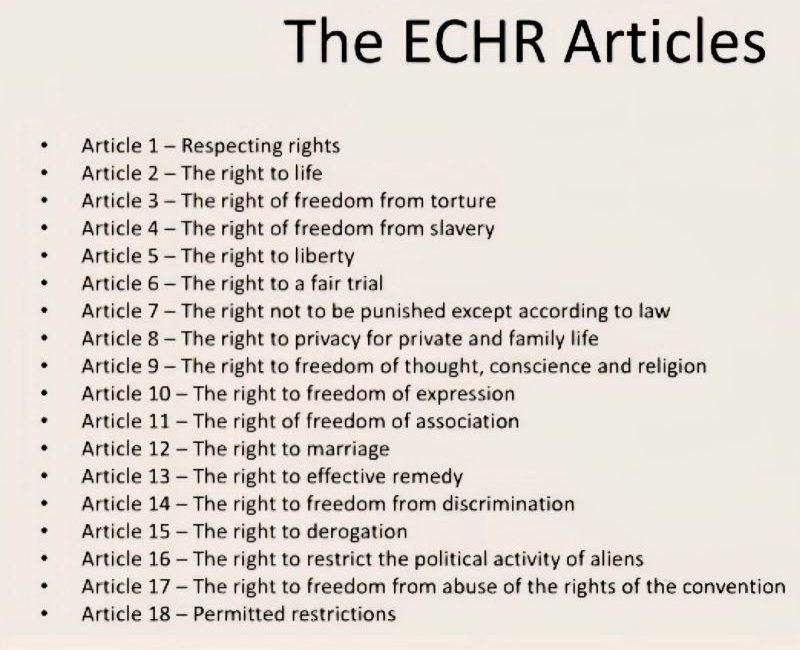
Which of the below rights do you want to remove from YOUR family?
What is it like working as a Contractor rather than in a staff position?
Posted to LinkedIn 24 Spetember 2025
The importance of welfare...
Explainer video originally posted on LinkedIn in September 2025
Originally posted to Linkedin July 2025
A Radical but Necessary Rethink: Should We Deflate the UK Housing Market?
A Radical but Necessary Rethink: Should We Deflate the UK Housing Market?
It’s no secret that UK housing is unaffordable for too many, average prices have jumped from 4x to over 7x annual wages in the last 25 years. And yet, the conversation rarely moves beyond rhetoric or scapegoating.
So here’s an uncomfortable but honest suggestion:
What if we deliberately cooled the housing market to reset affordability?
➡ Institutional investors have amassed passive gains, leveraging portfolios to buy even more.
➡ Independent landlords face reduced profitability, while first-time buyers remain locked out.
➡ Companies enjoy mortgage interest tax relief individuals don’t reinforcing imbalance.
➡ Homeowners cling to paper wealth, yet higher taxes and mortgage burdens leave them financially strained.
The goal? Make multi-home ownership less attractive as a wealth-building tool.
🧾 Incremental stamp duty from the third property onward
🏡 Capital gains tax exemption for second homes to unlock supply
📉 Normalize mortgage tax rules across companies and individuals
🔄 Require lenders to support borrowers through equity fluctuations
None of this is easy. But if housing remains a speculative asset instead of a social foundation, our economy and society will keep buckling under its weight.
Constructive disruption beats perpetual dysfunction.
More detail in the attached paper, would love to hear other perspectives — what would you do to rebalance the system?


The Rise of House Prices: Can Affordability Ever Return? - origingally posted to LinkedIn July 2025
For decades, UK house prices have outpaced wage growth, fundamentally reshaping homeownership. In the 1990s and early 2000s, there was correlation between wages and property costs, but affordability has since collapsed.
🔹 In 1990, the average home cost £53,600— 3.9 times the average annual wage (£13,800).
🔹 By 2000, prices had risen to £77,950, 4.1 times the average wage (£18,800).
🔹 Now in 2025: £268,228, a staggering 7.2 times the average wage (£37,400).
🏠 Who owns homes today?
This trend has shifted homeownership from individuals to investors, making ownership an unreachable dream for many. Calls for affordable housing are frequent, but real change demands financial reforms. If homes were still priced at four times the average wage, the average house would cost £149,600—a 44% reduction...
💡 The Challenge of Building Affordable Homes
If affordable homes were built to market-standard size and quality, house values could drop, triggering financial losses for investors, pension funds, and homeowners fearing negative equity.
Does negative equity truly harm homeowners who aren’t selling? With mortgage payments typically lower than rent, price fluctuations have little impact—so long as payments remain manageable.
🛠 Potential Solutions
A fairer mortgage system could protect homeowners and prevent negative equity issues:
✅ Lenders should accept property devaluation risks and honor original loan-to-value (LTV) ratios whenremortgaging, unless additional funds are borrowed.
✅ Banks must offer equal mortgage products to all homeowners, preventing higher costs for those trapped in negative equity.
Even with these changes, home movers in negative equity still face financial hurdles—not to mention opposition from industries thriving on rising house prices.
🚀 A Radical Reset?
One bold solution: Governments and local authorities build affordable homes, reinvesting sales proceeds into further development with the stated intent of reducing the cost of home ownership (and therefore the value of your own porperty). Transparent, large-scale communication would be key—acknowledging short-term disruption but framing it as a necessary step toward sustainable housing accessibility.
"We are resetting the housing market so people can afford homes—not just investors acquiring more properties. While this will spark debate on pensions and market stability, it's the only viable path to restore affordability."
Moreover, affordable housing initiatives could boost local economies, prioritizing construction firms within the communities they serve.
With homeownership slipping further out of reach, bold strategies may be necessary to return housing accessibility to ordinary buyers. The real question: Does the political and financial landscape allow for such a fundamental shift?
💬 What’s your take? Can housing affordability be restored, or is the system too deeply entrenched in property investment?
Misleading Narratives on Net Zero: A Missed Opportunity for Informed Debate - originally posted to LinkedIn June 2025
I was recently sent a link to an article by Jonathan Leake referencing a Kathryn Porter report in The Telegraph and asked for my opinion. After reading it, I have to admit I was disappointed. The piece framed ten levies and subsidies as evidence of how "Ed Miliband's net zero cusade is adding billions to Britions' energy bills"—but a closer look tells a different story.
Of these ten:
🔹 Four were closed by Conservative governments between 2017 and 2022—so they have nothing to do with Miliband.
🔹 One, the Warm Home Discount, is a vital support for low-income households during winter, completely unrelated to Net Zero.
That leaves five:
✔️ The Electricity Generator Levy—a windfall tax that ensures profits made by low-carbon generators from inflated gas-linked prices flow back into government, not consumers.
✔️ The Capacity Market Levy—applied to all electricity suppliers, funding essential grid upgrades.
✔️ The Climate Change Levy—in place since 2001, helping cut UK emissions significantly.
✔️ The Green Gas Levy—introduced in 2021 by a Conservative government to expand biomethane in the gas grid.
✔️ Contracts for Difference (CfD)—a mechanism supporting renewables while returning money to the government when electricity prices rise. In 2022/23 alone, this rebate totaled £4 billion.
What’s missing from the article?
❌ The fact that UK electricity prices are set by gas, not renewables.
❌ The comparative subsidies for fossil fuels—between 2016 and 2020 alone, these totaled £13.6 billion.
Miliband’s approach to Net Zero—through initiatives like GB Energy and Allocation Round 7—will take time to prove itself. But citing levies and subsidies from past governments, misrepresenting their purpose, and failing to provide basic energy market context? That’s lazy journalism, designed to stir outrage rather than encourage informed discussion.
It’s crucial that we challenge misleading narratives and promote a data-driven, fact-based dialogue on the UK’s energy transition. What are your thoughts?


Original Post to LinkedIn June 2025 - link below
Navigating Change & Finding Purpose
Last week’s Mental Health Awareness Week got me thinking about how unemployment has impacted me.
Leaving Vestas happened quickly—handled professionally, with a mutually beneficial outcome—but that didn’t make it any easier. After nearly four years of 50-hour weeks, suddenly having no schedule, no urgent priorities, no reason to start the day felt unsettling. I thrive on responsibility, so doing nothing was never an option.
So, I kept myself busy:
⛳ Played more golf (a tough sacrifice, but someone has to keep the greenkeepers accountable)
🌿 Tackled a garden that had been allowed to run wild
🏍️ Finally started working on my motorbike license—something I’d been meaning to do for 25 years
While applying for jobs and waiting on responses, the biggest boost has come from conversations with training providers, developers, and service providers in the renewables industry. Sharing insights, supporting growth, and staying engaged with an industry I care deeply about has been incredibly fulfilling. I might even explore consulting workshops while I decide on my next move.
🚀 Unemployment can be tough—it makes you second-guess yourself and your worth. But it’s also an opportunity to pause, recharge, tackle long-postponed goals, and give back to the industry that’s shaped so much of my career.
If you’re navigating a career transition, how have you kept momentum while figuring out your next steps?